6 Minute Read
This month, we sat down with Michael Attard of Hariri Pontarini Architects, the firm behind the striking architecture at Elm-Ledbury. The building has received significant industry recognition, including Best High-Rise Building Design from the Building Industry and Land Development Association (BILD), Best Amenities from the Federation of Rental-Housing Providers of Ontario (FRPO), and a Bronze Award for Residential Interior Design / Luxury Living from the International Design Awards.
Here is the full Q+A:
What was the guiding idea behind the design of Elm-Ledbury?
The guiding idea was that two buildings could do something one building never could - repair a void and create a complete community. This was a full city block given over to surface parking, a break in the urban fabric at a moment when the city needed the opposite. Elm and Ledbury sit at the heart of a four-building masterplan, each building addressing a different street, a different demographic, a different programmatic need - but all four working in concert around a shared public realm. From the beginning we were thinking about the mews, the parks, the retail animation at grade - not as amenities for residents alone, but as the connective tissue of the block, designed to invite the neighbourhood in and give it a reason to stay. Elm and Ledbury aren't standalone objects. They're the centre of something larger, and that relationship to the whole shaped every decision we made.
How did your approach to designing balance function and design?
We don't see those as competing forces - and Elm and Ledbury are a good example of why. The soft radius corners that give the buildings their approachable character also improve the pedestrian experience at grade. The minimal window-to-wall ratio that contributes to the quiet, considered aesthetic also significantly improves thermal performance and acoustic privacy. The bridges connecting the two buildings aren't just visually compelling - they're how residents move between shared amenities without going back to grade. Every design decision was interrogated for how it performed, not just how it looked.
How does Elm-Ledbury stand out in Toronto’s busy skyline?
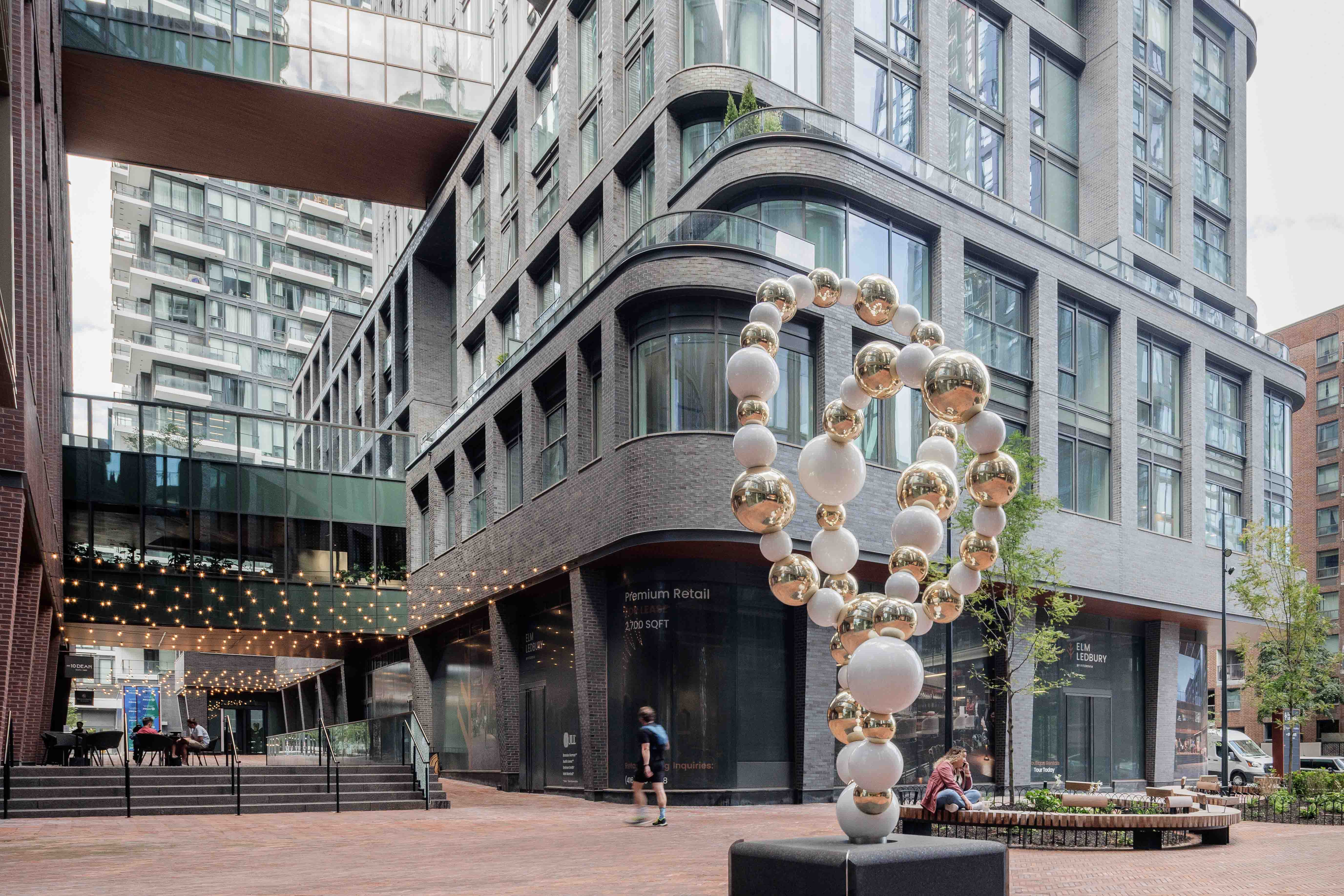
Honestly, by not trying to compete. So much of Toronto's skyline is driven by the ambition to be noticed - distinctive form, signature gestures, exhibitionistic style. We made a deliberate choice to reject that. The tower skins are intentionally restrained, allowing the buildings to sit coherently within the broader campus rather than shout for individual attention. What distinguishes Elm and Ledbury is the quality of what happens at ground level - the brick-lined mews, the softly curved bases, the animated retail, the public art. That's where the buildings earn their place in the neighbourhood.
Were there specific materials or construction methods used to ensure long-term quality and durability?
Brick was a foundational choice - and a deliberate one. It connects Elm and Ledbury to the brick and beam character of Queen Street to the south, but more importantly it's a material that ages with dignity. It doesn't require maintenance to look intentional- it deepens over time. The tapered columns at grade, the carefully resolved junctions between materials, the curved glass details at the corners - these are the kinds of decisions that separate buildings that endure from ones that simply impress on opening day. We wanted buildings that would look better in twenty years than they do today.
How did you approach the design of shared amenities to make them genuinely useful for residents?
We distributed amenity functions across both buildings rather than consolidating everything in one place, which keeps the buildings activated at multiple levels and gives residents reasons to move through the complex. The bridges are key to this - they allow Elm and Ledbury to share lower-level amenities while each maintaining exclusive rooftop experiences like pools and terraces. We were also deliberate about programming: an indoor basketball court, a Montessori facility, a dog spa, a virtual healthcare clinic. These aren't luxury flourishes for a brochure — they reflect the real diversity of how people live, and particularly how families live. The Elm was specifically designed around family needs, with larger two and three bedroom units and amenities that support children.
What role did sustainability and energy efficiency play in the design, and how does that benefit residents directly?
Sustainability was integrated into the design language rather than treated as a compliance exercise. The minimal window-to-wall ratio - which contributes to the buildings' quiet, considered aesthetic- directly reduces heat loss and improves thermal comfort for residents. The rooftop gardens manage stormwater and reduce urban heat island effect while giving residents meaningful outdoor space. The approved tower separation of 12.6 metres was voluntarily increased to 15 metres to improve access to natural light and reduce overlook - a decision that cost density but improved liveability. These choices compound over time into buildings that perform well, feel comfortable, and cost less to operate.
How does the building connect residents to the Garden District and enhance that living experience?
The project was conceived as a transition - between the dense downtown core to the west and the lower-scale residential neighbourhoods to the east. Rather than turning its back on that responsibility, the masterplan leans into it. The POPS, the public park, the brick-lined mews - these are all publicly accessible spaces that invite the neighbourhood in. The retail strategy was designed to complement and support the area's social and economic diversity, not simply serve residents. The goal was always to create a destination that the broader community would claim as their own, not a gated amenity for people who happen to live there.
What standout features of Elm-Ledbury stand out to your team architecturally?
The mews is the heart of it - the moment you move through the brick-lined passage, past the bridges overhead, and into the communal open space, you understand what the project is trying to do. The proportion and scale of the brick bases are something we're particularly proud of - the way the large piers frame the windows and slowly step back before engaging with the towers above gives the buildings a legibility and weight that most contemporary residential construction doesn't attempt. And the bridges - both as physical connectors and as architectural gestures spanning the public realm - capture something essential about what Elm and Ledbury are: two distinct buildings that are also, fundamentally, one community.
Discover Elm-Ledbury. Now leasing, book your tour today.